


Tips
November 9, 2026
·

You need a truck whose towing capacity, payload and hitch rating all exceed the loaded weight of the specific trailer you rent, plus a working brake controller, because California requires brakes on any trailer coach of 1,500 pounds or more. Towing capacity alone is not enough: payload is usually the number that runs out first. Get the trailer's real weights from its federal label or from our Manager before you book a self-tow trip, and if the numbers do not line up, choose delivery instead.
We will not tell you that a particular truck can pull a particular trailer, because that depends on figures printed on your truck and the trailer, checked unit by unit.
Eight terms decide it, and every one has to pass. A single failure means the combination is not safe or legal, however strong the truck feels.

GVWR (gross vehicle weight rating) is the most a fully loaded vehicle or trailer may weigh, including water, propane, food and gear. Dry weight is the trailer as it left the factory, empty. The National Highway Traffic Safety Administration booklet Towing a Trailer: Being Equipped for Safety warns that the empty weight some manufacturers list is not enough on its own for choosing a tow vehicle. Plan around the loaded weight, and treat the trailer's GVWR as the ceiling.
Tongue weight is the downward force the trailer coupler puts on the hitch ball. The same NHTSA booklet notes that too little tongue weight can cause the trailer to sway, while too much can unload the front wheels of the tow vehicle, which hurts steering and braking. Follow your trailer and hitch makers' recommended range; a published hitch weight is usually measured empty.
Towing capacity, also called the trailer weight rating, is the heaviest trailer the truck's maker says it can pull. SAE J2807, an SAE International recommended practice, sets minimum performance criteria at the gross combination weight rating (GCWR) and a method for calculating trailer weight rating for vehicles up to 14,000 pounds GVWR, so it is worth checking whether your truck's published rating follows it. NHTSA points out that the rating can change with the truck's equipment, so a cab, bed, axle ratio or engine difference can move the number.
Payload is what the truck can carry in the cab and bed, and the trailer's tongue weight counts against it. Your truck's tire and loading information placard, usually on the driver's door jamb, lists the combined weight of occupants and cargo the truck can carry. Passengers, gear, hitch hardware and tongue weight all count, and going over that figure overloads the truck whatever its towing capacity.
GCWR is the permitted combined weight of truck, trailer, people, fuel and cargo. GAWR (gross axle weight rating) is what each axle can carry, and NHTSA says the tow vehicle's GAWR must not be exceeded.
Hitches are sorted into classes by the weight they handle, and each piece (receiver, ball mount, ball, coupler) carries its own stamped rating; the weakest part sets your limit. The California Highway Patrol notes that Vehicle Code section 29004 requires a hitch strong enough for the weight being towed, plus a safety chain that can control the trailer if the hitch fails.
A weight-distributing hitch uses spring bars to shift some tongue weight forward. NHTSA describes it as a remedy that transfers weight back to the front axle of the tow vehicle. It does not raise your payload or towing capacity.
A brake controller in the truck cab runs the trailer's electric brakes. NHTSA notes that controllers usually offer automatic and manual control and may need adjusting for different trailer loads. Without one, the trailer's brakes do nothing.
Read the federal certification label on the trailer itself. Under federal rule 49 CFR 567.4, a trailer's label sits on the forward half of the left side and must show the manufacturer, month and year of manufacture, GVWR, GAWR for each axle, a compliance statement and the vehicle identification number (VIN).
For a rental, ask before you book: send your truck's towing capacity, payload and hitch rating, and ask for the trailer's GVWR and hitch weight. Our site does not yet publish ball size, hitch type or brake controller needs, so confirm those directly.
Only one trailer page lists weights today. Here is what the unit pages and the Murrieta RV rental prices page show, as of November 9, 2026.
Weights published
Weights not published (confirm on the label or with the Manager)
Rates usually exclude cleaning, deposits and delivery. Still choosing a size? Compare the small travel trailer and large bunkhouse travel trailer categories, since length and bunk count tend to track weight.
Run Dolly's published numbers against your truck in this order. The truck figures are an invented example, not a real model.
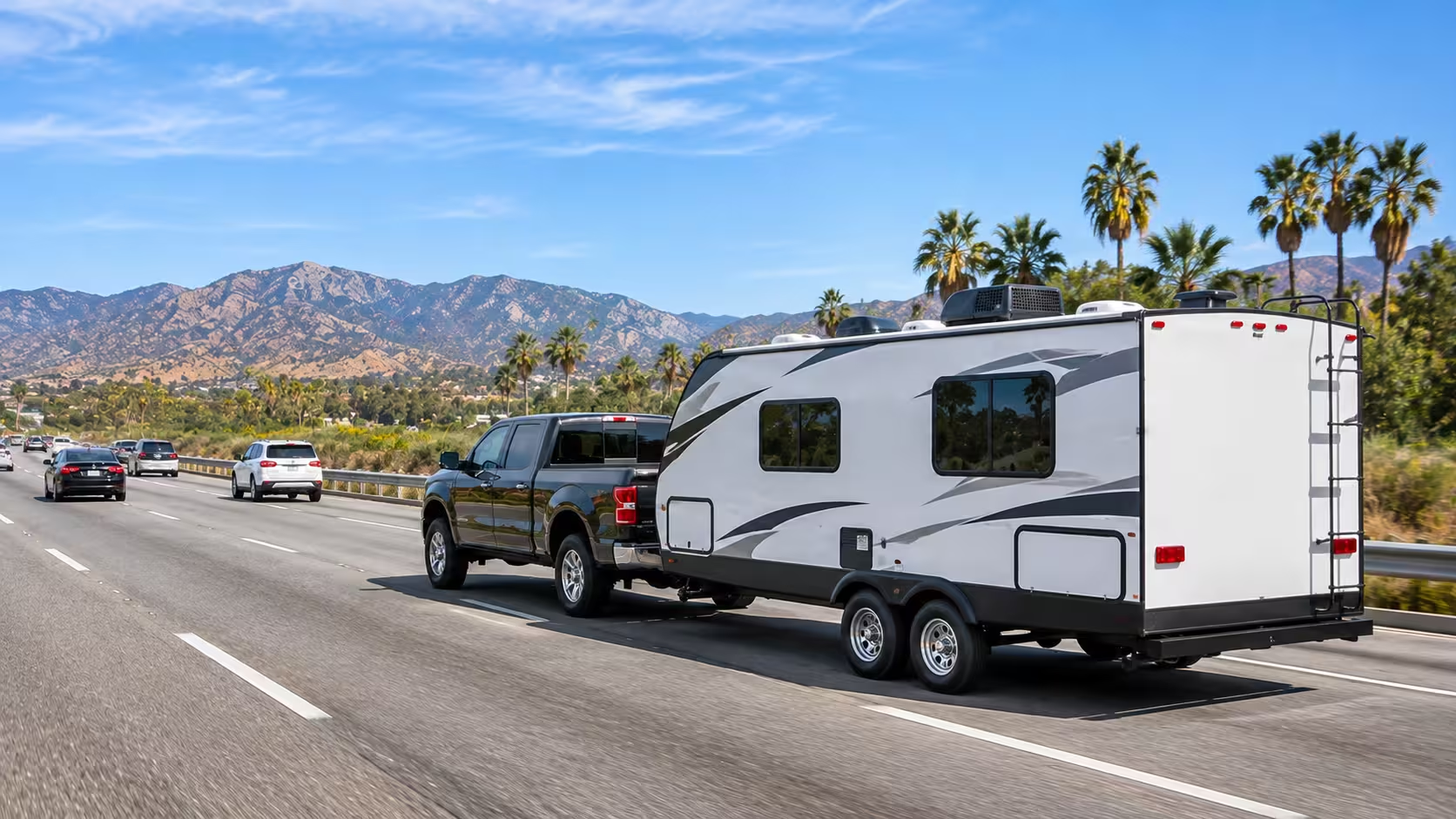
California caps towing speed at 55 miles per hour and keeps you to the right. Our pickup is in Murrieta right off Interstate 15 and Interstate 215, so these rules apply from the first on-ramp. The California Highway Patrol and DMV list the main ones:
Tow it yourself only if every number passes with room to spare. Otherwise, delivery is the easier answer.
Send your truck's ratings and we will help check the fit or quote delivery. Contact our Manager with your dates, or View available RVs to see what is open. You can also start from the Get Lost RV Rentals home page.
Sometimes, but only if its payload, towing capacity and hitch rating all exceed that trailer's loaded numbers. Check the door placard against the trailer's hitch weight first.
In practice, yes. California requires brakes on trailer coaches of 1,500 pounds or more, and electric trailer brakes only work when the truck has a controller connected to them.
No faster than 55 miles per hour, in the right lane or either of the two right lanes where there are four or more lanes in your direction.
Probably not, if its GVWR is 10,000 pounds or less, because a CHP bulletin says a noncommercial Class C covers trailers up to that rating. Dolly's page lists a gross weight of 9,620 pounds; confirm the GVWR on its federal label.
Ask for delivery and setup instead. We deliver to places like Temecula wineries and Lake Skinner, with delivery quoted per trip, so confirm your site allows a delivered rental.
